For decades, digital businesses have followed a familiar structure: centralized ownership, top-down decision-making, and value flowing primarily to shareholders. But a new model is emerging—Decentralized Autonomous Organizations (DAOs). Powered by blockchain technology and smart contracts, DAOs are introducing a different way to organize digital platforms, coordinate communities, and distribute value.
While still evolving, DAO models are beginning to reshape how digital products, platforms, and ecosystems operate.
This article explains what DAOs are, how they work, where they are being used, and why they could become a significant organizational model for the next generation of digital businesses.
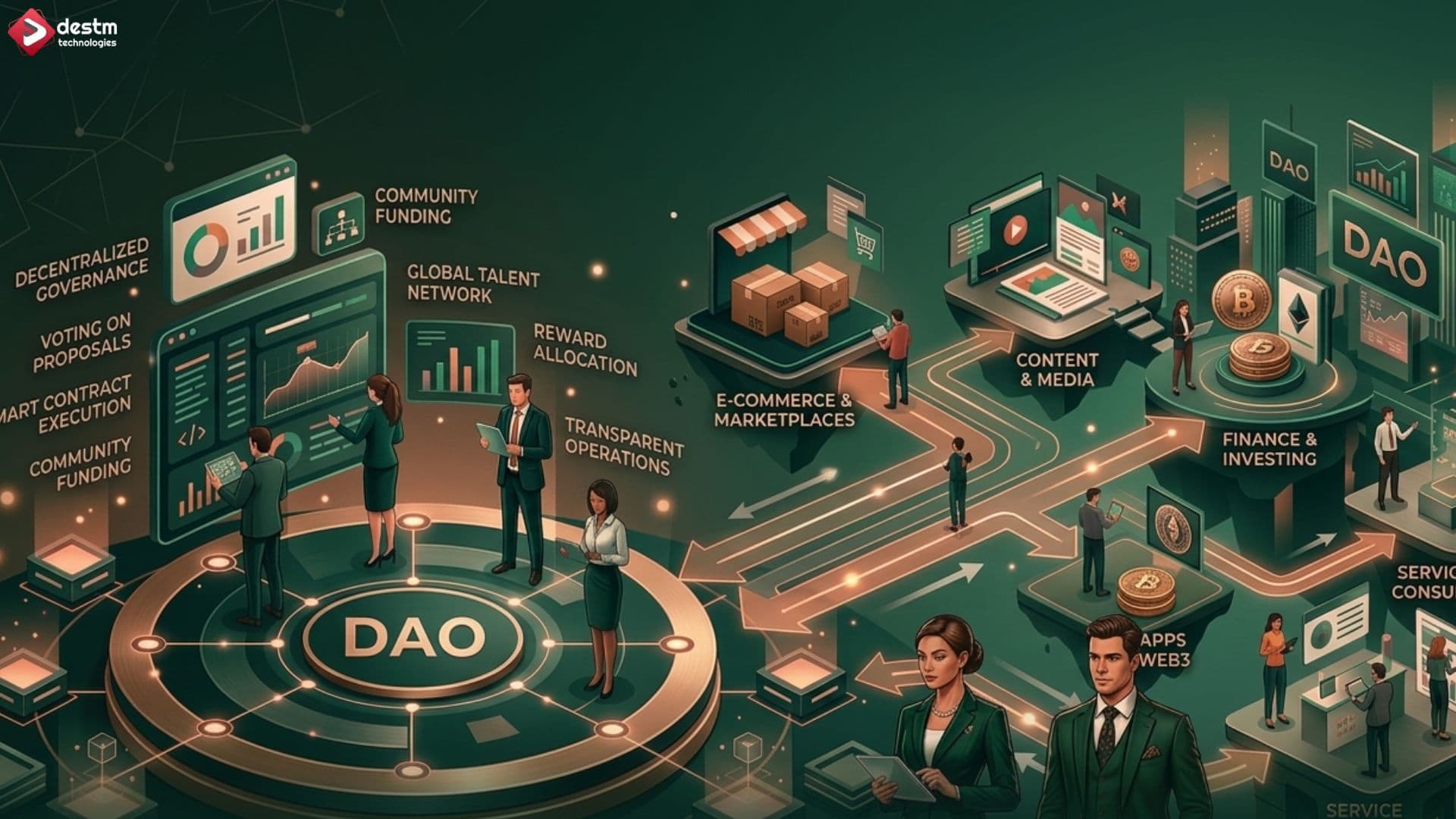
A Decentralized Autonomous Organization (DAO) is an internet-native organization governed by code and community rather than traditional management hierarchies.
Instead of executives making decisions, governance is typically handled through token-based voting systems where stakeholders propose and vote on changes.
Key characteristics of DAOs include:
Decentralized governance
Smart contract automation
Transparent decision-making
Token-based incentives and ownership
In simple terms, a DAO is a digital organization where rules are encoded in software and decisions are made collectively.
DAOs operate through blockchain-based infrastructure that manages governance, finances, and operational rules.
1. Smart Contracts
Smart contracts define the rules of the organization. They automatically execute decisions once voting thresholds are reached.
2. Governance Tokens
Participants hold tokens that represent voting power or ownership within the DAO ecosystem.
Built with CuberiQ
3. Community Proposals
Members submit proposals—such as funding initiatives, platform changes, or partnership approvals.
4. On-Chain Voting
Token holders vote on proposals, and approved changes are executed automatically.
This structure allows organizations to function without centralized management, relying instead on transparent, rule-based coordination.
Several factors are driving the rise of DAO-based digital organizations.
Global Communities
Digital platforms now operate across borders, making traditional corporate structures less flexible for community-driven ecosystems.
Trust and Transparency
Blockchain-based governance allows stakeholders to verify decisions and transactions publicly.
Programmable Incentives
Token economies enable contributors, developers, and users to share in the value created by the ecosystem.
Automation
Smart contracts reduce administrative overhead by automating governance and financial processes.
Together, these factors allow DAOs to operate as community-owned digital platforms.
While many DAOs began in crypto communities, the model is expanding into broader digital industries.
Platform Governance
Some decentralized platforms allow users to vote on product features, policies, and development priorities.
Creator Economies
DAOs can fund creators collectively and distribute revenue among community members.
Venture and Investment DAOs
Communities pool capital and collectively decide which projects to invest in.
Open-Source Development
Developers collaborate globally while governance tokens align incentives and reward contributions.
Digital Commerce Ecosystems
Tokenized marketplaces can distribute ownership among merchants, users, and developers.
These examples show how DAOs enable collaborative ownership models for digital platforms.
Transparency
All governance actions and financial transactions are recorded on the blockchain.
Global Participation Anyone with internet access can potentially participate in governance.
Alignment of Incentives
Contributors, users, and developers can share in the ecosystem’s success.
Reduced Administrative Overhead
Smart contracts automate many operational tasks.
Innovation Through Community
Open participation can accelerate experimentation and product evolution.
For digital-native businesses, this structure can unlock new collaboration and ownership models.
Despite their potential, DAO models still face several challenges.
Governance Complexity
Large communities can struggle with decision-making efficiency.
Regulatory Uncertainty
Legal frameworks for decentralized organizations are still evolving.
Security Risks
Smart contract vulnerabilities can expose organizations to financial risk.
Participation Inequality
Token concentration can lead to governance dominated by a few participants.
Coordination Difficulty
Without strong leadership structures, projects can struggle with execution.
These issues highlight that DAO models are still in an early stage of maturity.
Over the next decade, DAO models are likely to evolve into hybrid structures combining:
Decentralized governance
Professional operational teams
Automated smart contract infrastructure
Instead of replacing traditional companies entirely, DAOs may complement them by enabling community-driven innovation layers around digital platforms.
Industries such as finance, digital marketplaces, gaming, and creator economies are especially likely to experiment with DAO governance.
As tools improve and regulations become clearer, DAO models could become a standard framework for internet-native organizations.
DAO models represent a fundamental shift in how digital businesses can be structured. By combining blockchain infrastructure, tokenized incentives, and community governance, DAOs introduce a new paradigm where ownership, decision-making, and value creation are distributed across participants rather than concentrated in a central authority.
At Destm Technologies, we closely track emerging digital governance models such as DAOs and tokenized ecosystems. As commerce platforms, digital communities, and decentralized technologies converge, businesses will increasingly explore how these models can create more transparent, collaborative, and scalable digital ecosystems.
The future of digital business may not be purely centralized or decentralized—it will likely be intelligently hybrid.
Ready To Transform Your E-commerce Business?
Let's discuss your project and explore how we can help you achieve your goals.