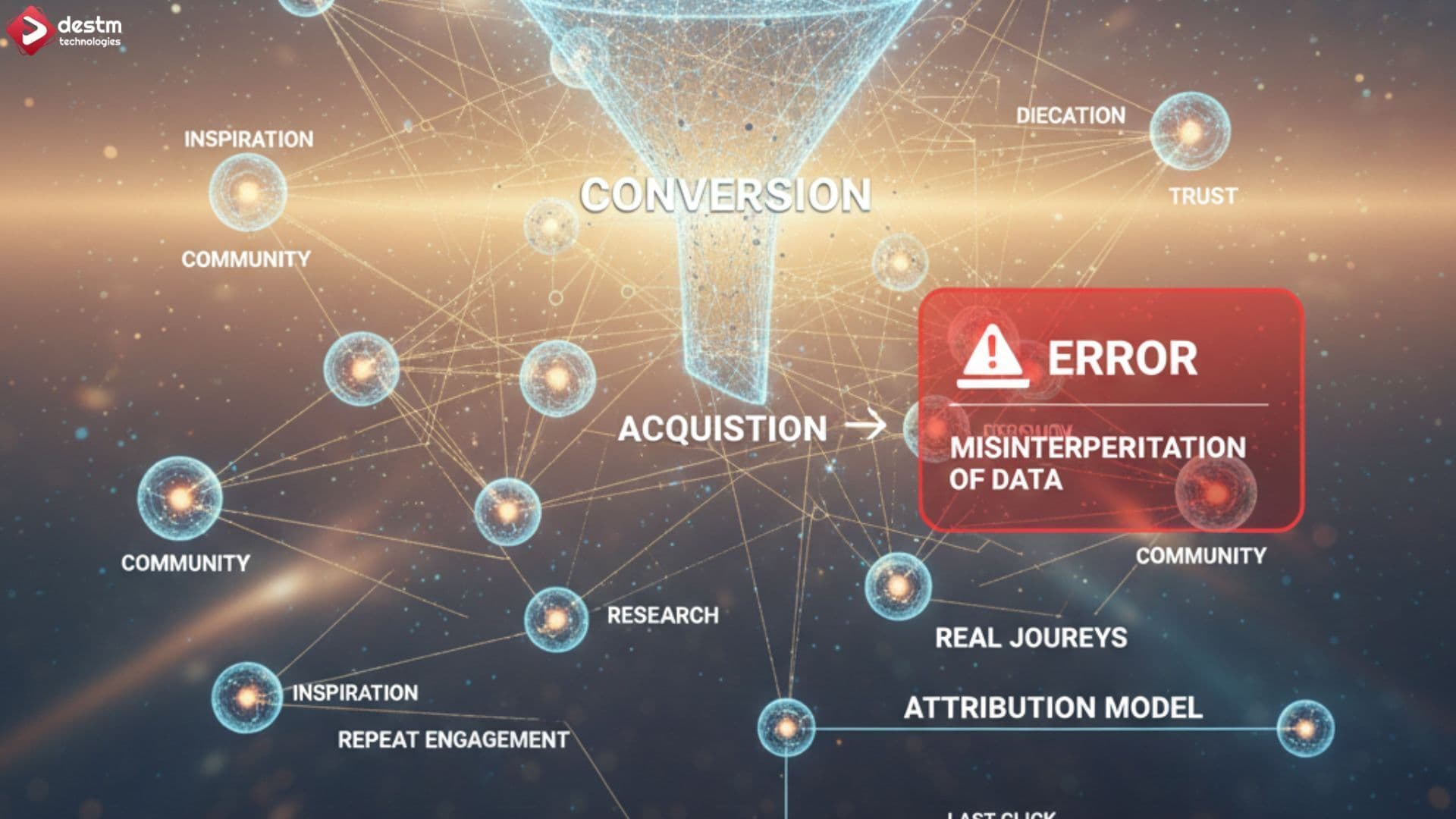
For years, marketers have relied on attribution models to answer a deceptively simple question:
“Where did this customer come from?”
The dashboards look clean.
The charts feel scientific.
The conclusions feel actionable.
And yet—most attribution models are fundamentally lying about acquisition.
Not out of malice.
Out of structural limitations, outdated assumptions, and oversimplified logic that no longer match how people actually discover, evaluate, and buy today.
Let’s unpack why attribution breaks down—and what to do instead.
Most attribution models—last-click, first-click, even multi-touch—are built on a linear journey assumption:
User sees ad
User clicks
User converts
Credit assigned
But modern acquisition doesn’t work like a straight line. It looks more like:
LinkedIn post read weeks ago
A brand name remembered subconsciously
A Google search days later
A review checked on a marketplace
A WhatsApp recommendation
Then finally… a “direct” visit and purchase
Attribution systems only see what they can track, not what actually influenced the decision.
So they over-credit measurable touchpoints and under-credit meaningful ones.
Last-click attribution answers the wrong question.
It doesn’t ask:
Built with CuberiQ
What created demand?
It asks:
What happened right before conversion?
That’s like crediting the cashier for convincing you to buy—while ignoring the brand, pricing, product, reviews, and trust built over weeks or months.
Common distortions caused by last-click models:
Brand search looks like a “top acquisition channel”
Retargeting appears more effective than prospecting
Upper-funnel content gets undervalued or killed
Paid channels fight each other for credit, not impact
Last-click doesn’t measure influence.
It measures proximity to purchase.
Those are not the same thing.
Multi-touch attribution sounds smarter—and in theory, it is.
In practice, it still lies in subtler ways.
Why?
a) It only includes trackable touchpoints
Dark social, word-of-mouth, offline exposure, and brand memory don’t exist in the model.
b) Weighting is arbitrary
Why should first-click get 40% and last-click 40%?
Why not 10% and 70%?
Most weighting models are opinion disguised as math.
c) It assumes equal causality
Just because a touchpoint existed doesn’t mean it mattered.
Seeing five retargeting ads doesn’t mean they caused the purchase—it may mean the buyer had already decided.
One of the most dangerous lies attribution tells is this:
“This channel acquired the customer.”
In reality, channels don’t acquire customers—intent does.
Paid search often captures existing intent
SEO often reflects brand trust
Social often creates future demand
Email often serves retention, not acquisition
Attribution systems collapse intent creation and intent capture into the same bucket—and that leads to terrible decisions, like:
Cutting awareness spend because it doesn’t “convert”
Over-investing in bottom-funnel tactics
Starving the system that creates demand in the first place
With:
Cookie deprecation
iOS privacy changes
Platform data silos
Walled-garden reporting
Attribution models now operate on partial visibility.
Platforms still show “results,” but:
Each platform claims more credit than is possible
Cross-channel influence disappears
Incrementality becomes guesswork
The data looks precise—but it’s incomplete precision, which is more dangerous than uncertainty.
This doesn’t mean you should abandon measurement. It means you should stop asking attribution to do a job it can’t do.
a) Measure incrementality, not credit
Use:
Holdout tests
Geo experiments
Time-based comparisons
Ask:
“What happens when this channel is removed?”
Not:
“How much credit does it get?”
b) Track demand signals, not just conversions
Look at:
Brand search lift
Direct traffic trends
Returning visitor growth
Conversion rate stability over time
These show demand creation, not just capture.
c) Evaluate channels by role, not ROI alone
Some channels:
Create awareness
Build trust
Reduce friction
Accelerate decisions
Judging all of them by last-click ROI is like judging a football team only by goals scored.
d) Use attribution as a directional signal, not truth
Attribution is a compass—not a map.
Useful for:
Spotting trends
Detecting anomalies
Comparing changes over time
Dangerous when used for:
Budget cuts
Channel shutdowns
Short-term optimization decisions
Stop asking:
“Which channel acquired this customer?”
Start asking:
“What combination of experiences made this customer confident enough to buy?”
That shift—from credit assignment to decision understanding—is where modern growth teams win.
At Destm Technologies, we don’t treat attribution dashboards as truth—we treat them as partial signals.
Our approach to acquisition and growth is built around decision intelligence, not channel credit. That means:
Designing measurement frameworks that focus on incrementality, not vanity ROI
Separating demand creation from demand capture to avoid starving long-term growth
Aligning marketing, UX, and performance data to understand why users convert, not just where they clicked
Building experimentation systems that survive privacy changes, cookie loss, and platform bias
Instead of asking “Which channel gets the credit?”, we help teams answer the harder—and more valuable—question:
“What actually moved the customer to act?”
That’s how sustainable acquisition is built in a post-attribution world.
Ready To Transform Your E-commerce Business?
Let's discuss your project and explore how we can help you achieve your goals.